
8,000 Metres of Humility: What Nepal's Himalayan Peaks Keep Teaching Us
8,000 Metres of Humility: What Nepal's Himalayan Peaks Keep Teaching Us
Why the mountain always gets the final word, and why that's exactly why we climb it
There is a phrase that keeps surfacing every autumn and spring in Nepal's mountaineering circles, repeated so often by expedition leaders that it has become something close to doctrine: the mountain always has the final word.
It sounds almost like a cliché until you watch it happen in real time. Hundreds of climbers, months of preparation, tens of thousands of dollars in permits and logistics, fixed ropes already reaching the summit. And then, in a matter of days, all of it was set aside because the mountain said no.
That is exactly what happened on Manaslu this autumn. And it is exactly what has happened, in one form or another, on nearly every 8,000-metre peak in the Himalaya for the better part of a century.
Autumn 2026: Manaslu Closes Without a Single Summit
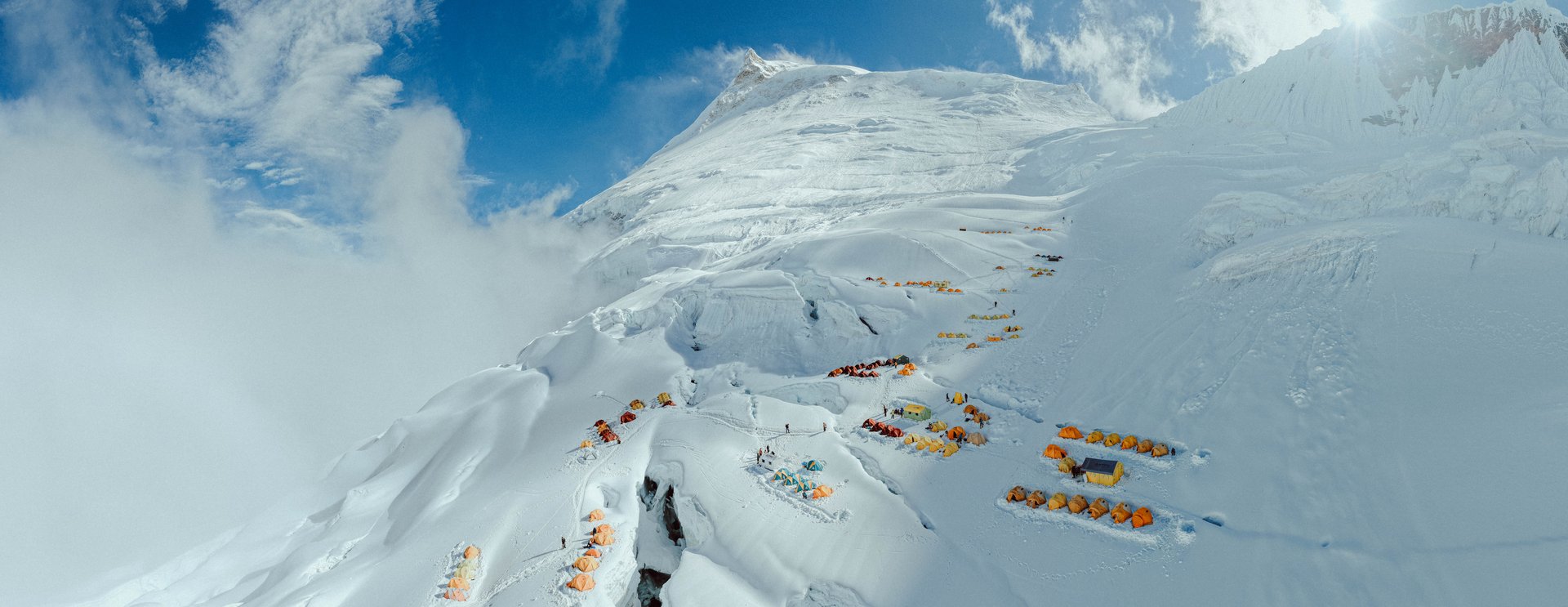
Manaslu, the world's eighth-highest mountain at 8,163 metres, had one of its most anticipated seasons on record this autumn. Nepal's Department of Tourism issued 493 climbing permits across 41 expedition teams, a record number of climbers hoping to stand on top of the mountain many now use as their first 8,000-metre objective before attempting Everest.
By September 17, a rope-fixing team had reached the summit, opening the route for the season. Everything was in place for a historic year.
Then the weather changed.
Persistent snowfall over the following two weeks buried base camp under roughly three feet of snow, with far more accumulating higher on the mountain. Villagers in Samagaun, near the mountain's base, reported it had never rained and snowed like this before. Climbers waited at high camps, hoping for a window. It never came.
Seven Summit Treks, the largest operator on the mountain, made the call first. Expedition leader Chhang Dawa Sherpa put it simply: "When it comes to the technical challenges of an expedition, we prepare, adapt, and find a way to tackle them. But there is one thing we can never overcome: snowfall, wind, and mountain conditions are beyond our control."
Other major operators followed within days. Elite Exped (the outfit founded by the late Nims Purja, who himself died in an avalanche earlier this year) wrote on Instagram: "We know how tough it is for our climbers who came here with so much hope, because we know what this journey meant to them."
By the time the season was formally closed, four climbers had died, roughly a thousand people had been evacuated from the mountain, and not a single client had reached the summit, despite the highest number of permits Manaslu has ever sold. Madison Mountaineering, one of the teams that broke camp, offered a line that has since been quoted across the climbing world: "The mountains always have the final word."
This Is Not a New Lesson
What makes Manaslu 2026 remarkable is not that it happened. It is how familiar it feels to anyone who has studied Himalayan climbing history. The mountains have been teaching this same lesson, in different forms, for as long as people have tried to climb them.
Annapurna, 1950: the first 8,000er, and the price of the first ascent. When Maurice Herzog and Louis Lachenal became the first climbers ever to summit an 8,000-metre peak, they paid for it with nearly all of their fingers and toes to frostbite. Annapurna held onto its reputation as the "Killer Mountain" for decades afterward. For much of the late twentieth century, its fatality-to-summit ratio was the worst of all fourteen 8,000ers: for every three climbers who reached the top, roughly one did not come home. That ratio has fallen sharply in the last decade as forecasting and route-fixing have improved, but the mountain's message has never really changed: reaching the summit and surviving it are two separate achievements.
Nanga Parbat, 1934 and 1937: the mountain that earned its name the hard way. Long before Manaslu or Annapurna claimed their reputations, Nanga Parbat was already known among European climbers as one of the most punishing peaks on Earth. German expeditions in the 1930s were repeatedly caught by storms high on the mountain; the 1934 expedition alone lost several climbers and porters to a single blizzard near the summit ridge. It would be decades before anyone stood on top and came back to tell the full story of what the mountain demanded in return.
K2, 1986: the "Black Summer." Thirteen climbers died on K2 in a single season, several of them trapped in a storm high on the mountain after a rare, hard-won stretch of good weather convinced multiple teams to push for the summit at once. It remains one of the deadliest seasons in the history of high-altitude mountaineering, and a permanent reminder that a good weather window is not the same thing as a safe one.
Everest, 1996: perhaps the most well-known cautionary tale in mountaineering. Eight climbers died in a single day when a storm rolled in during multiple summit pushes, a tragedy made famous well beyond the climbing world through Jon Krakauer's Into Thin Air. The lesson that emerged from it, that summit fever can override the judgment even of the most experienced guides and clients, has shaped expedition protocol on every 8,000-metre peak since.
The details differ. The terrain differs. But the pattern does not: the mountain sets the terms, and every climber and outfitter who has lasted more than one season has learned to listen for them.
Respect, Not Conquest
There's a phrase climbers use that outsiders sometimes find strange: nobody "conquers" a mountain. You don't beat Manaslu, or Annapurna, or Everest. At best, the mountain allows you to stand on its summit for a few minutes, on a day when the wind and the snow happen to let you through, and then it expects you to leave.
That's not poetic exaggeration. It's closer to an operating principle. The teams that made the decision to close Manaslu this season without a single summit weren't failures. They were doing exactly what serious mountaineering asks of you: reading the mountain honestly, and choosing everyone's safe return over a flag on the summit ridge.
This is the same principle every guide at AltiPro Adventures operates by. We prepare meticulously: logistics, acclimatization, weather forecasting, experienced Sherpa teams, because preparation is within our control. Snowfall, wind, and avalanche risk are not. When a mountain says no, whether that's on a trek in the Annapurna region or an expedition on an 8,000-metre giant, the right response has never changed in seventy years of Himalayan climbing: you listen, you retreat, and you come back another season.
The mountain will still be there. That's the whole point.
Planning a Himalayan trek or expedition? AltiPro Adventures has been guiding climbers through Nepal's highest peaks with safety-first expedition planning: together, beyond limits.