
Khumbu Icefall Explained: The Most Dangerous Part of Everest
Khumbu Icefall Explained: The Most Dangerous Part of Everest
Long before climbers reach the death zone, the summit ridge, or the famous Hillary Step, they have to get through a stretch of glacier that many veteran guides consider more dangerous than anything above it. The Khumbu Icefall sits at the very start of the South Col route, just above Everest Base Camp, and it has earned its reputation the hard way. Understanding what it is, why it behaves the way it does, and how teams like the Icefall Doctors manage it each season is essential reading for anyone researching an Everest expedition.
This guide breaks down the Khumbu Icefall in plain terms: what it actually is, why the ice keeps moving, how the ladder crossings work, why crevasses make this section so unpredictable, the real risks involved, who the Icefall Doctors are, and when climbers typically cross to keep exposure as low as possible.
Climbers often expect the summit push to be the scariest part of an Everest expedition. Our guides consistently tell first-timers the opposite. The Khumbu Icefall is usually the moment reality sets in, because it is technical, exposed, and moving beneath your feet from the very first crossing.
What Is the Khumbu Icefall?
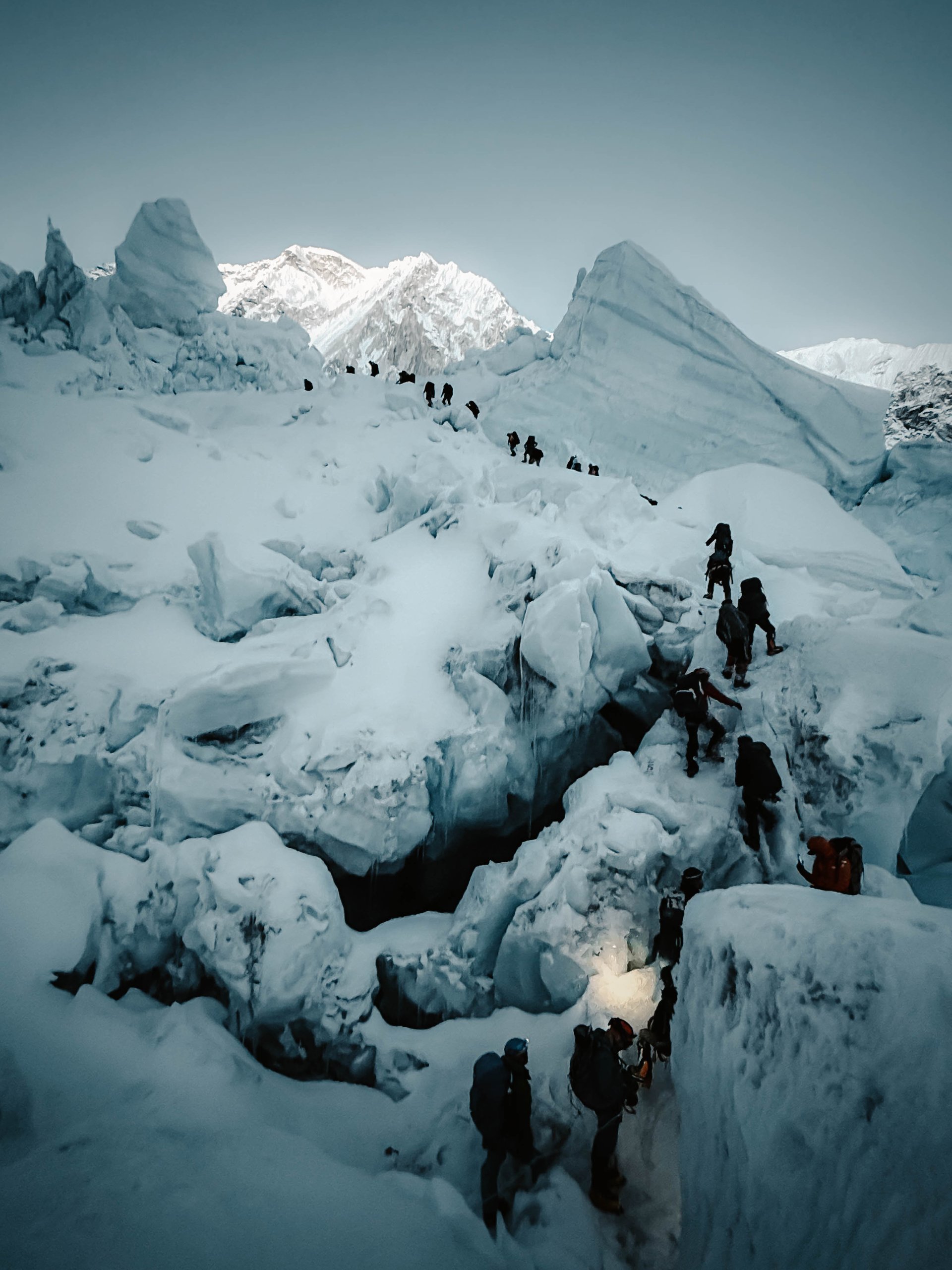
The Khumbu Icefall is a roughly 600-metre stretch of the Khumbu Glacier, located on the southeastern side of Everest between Base Camp at 5,364 metres and Camp 1 at around 6,000 metres. It forms where the glacier spills out of the Western Cwm and drops steeply down a section of the mountainside, breaking apart into a chaotic maze of towering ice blocks, deep fissures, and unstable snow bridges as it goes.
Unlike a smooth glacier field, the icefall looks almost like a frozen ocean caught mid-wave, with jumbled blocks of ice called seracs stacked unpredictably on top of each other, some of them as large as multi-storey buildings. It is the first major obstacle every climber on the standard South Col route has to cross, and for decades it has also been the compulsory gateway for anyone attempting Lhotse or Nuptse by their standard routes as well.
Khumbu Icefall Quick Facts
| Detail | Approximate Figure |
|---|---|
| Location | Between Everest Base Camp and Camp 1 |
| Elevation range | Roughly 5,364 m to 6,000 m |
| Vertical gain through the section | Around 600 m |
| Width | Roughly 500 m at its broadest points |
| Daily glacier movement | Approximately 1 to 2 metres per day |
| Typical ladders fixed per season | Roughly 20 to 50, depending on conditions |
| Typical crossing time for climbers | Around 4 to 8 hours, depending on fitness and traffic |
These figures vary meaningfully from season to season based on snowfall, temperature, and how the glacier has shifted since the previous year, so treat them as general planning ranges rather than fixed numbers for any specific expedition.
For a full picture of how the icefall fits into the broader climb, from Base Camp to the summit, see our complete Everest Expedition route breakdown.
Why the Khumbu Icefall Moves
The Khumbu Icefall is not a static obstacle. It is part of a living glacier that is constantly sliding downhill under its own weight, a movement typically estimated at somewhere around 1 to 2 metres per day. That might not sound like much, but compounded daily across a climbing season, it is enough to open new crevasses, topple seracs that were stable the week before, and shift the safest line through the icefall on a near-constant basis.
This is the central reason the Khumbu Icefall is treated differently from every other section of the mountain. On the Lhotse Face or the summit ridge, the terrain itself is essentially fixed, and the primary risks are weather, altitude, and fatigue. In the icefall, the terrain itself is the hazard, and it changes shape while climbers are standing on it.
A few forces drive that constant movement:
- Gravity and gradient. The icefall sits on one of the steepest sections of the glacier's overall path, which accelerates its flow compared to the relatively flat Western Cwm above it.
- Underlying rock terrain. The glacier is flowing over uneven bedrock, which causes some sections to move faster than others, tearing the ice apart into the crevasses and seracs that define the icefall's character.
- Temperature swings. Daytime warming softens ice and snow bridges, while overnight refreezing hardens them again, a daily cycle that keeps the structure genuinely unstable rather than settling into anything predictable.
Our guiding team reminds every climber before their first icefall rotation that the route they cross on day one will not be the same route by the final rotation. Ladders get repositioned, sections get rerouted, and what felt solid a week earlier can be gone entirely. Never assume yesterday's line is still today's line.
Ladders: The Icefall's Signature Feature
The image most people associate with the Khumbu Icefall, aluminum ladders lashed together and laid horizontally across dark crevasses, is not an exaggeration. It is standard practice, and it remains the most efficient way to bridge gaps that are otherwise far too wide and unstable to cross safely on foot.
Ladders are typically fixed by the Icefall Doctors using aluminum sections, sometimes multiple ladders lashed end to end or side by side for wider crevasses. Climbers cross wearing crampons, using their ice axe for balance, and clipped into fixed ropes running alongside the ladder using a jumar or ascender for security. The technique looks simple from photographs but takes real practice, since crampon points on aluminum rungs, combined with a loaded pack and thin air, is a different experience from anything most climbers have trained for at home.
Key points climbers should know about ladder crossings:
- Multiple ladders per crossing are common for the widest crevasses, sometimes three or four lashed together.
- Ladders shift with the glacier and need regular readjustment throughout the season, which is part of why the Icefall Doctors continue working even after the initial route is set.
- Vertical ladder sections also appear on some of the icefall's steeper ice walls, not just horizontal crevasse crossings.
- Practicing ladder technique before departure, even on a horizontal ladder laid across a gap at a climbing gym or training centre, genuinely helps first-time climbers move with more confidence and less hesitation once they are on the real thing.
The single biggest confidence issue we see on a climber's first ladder crossing is looking down. Guides consistently coach climbers to fix their eyes on the far end of the ladder, keep a steady rhythm, and trust the fixed line rather than the ladder itself for security.
Crevasses: Hidden and Visible Hazards
Crevasses are deep cracks in the glacier ice, and the Khumbu Icefall has an unusually high concentration of them due to the steep gradient and uneven bedrock underneath. Some are visible from a distance, gaping and obvious. Others are covered by a thin layer of snow that can look completely solid while hiding a drop of many metres underneath, which is part of why fixed ropes and a set, tested route matter so much through this section.
Types of Crevasse Risk in the Khumbu Icefall
| Type | Description | Primary Hazard |
|---|---|---|
| Open crevasse | Visible crack in the ice, often crossed by a ladder | Fall risk if ladder or footing fails |
| Hidden crevasse | Covered by a snow bridge that looks solid | Sudden collapse underfoot |
| Widening crevasse | An existing crack that grows during the season | Ladders becoming undersized or unstable |
| New crevasse | Opens suddenly as the glacier shifts | The route may need to be rerouted entirely |
This is one of the clearest reasons solo or unguided travel through the Khumbu Icefall is strongly discouraged. The fixed line and the tested route exist precisely because the safe path is not something a climber, however experienced, can reliably judge from the surface alone.
Risks in the Khumbu Icefall
The Khumbu Icefall carries a different risk profile than the rest of the Everest climb. Above Camp 2, the main dangers are altitude, cold, and exhaustion. In the icefall, the dominant danger is objective hazard, meaning risk that exists independent of a climber's skill or fitness, such as a serac collapsing or an avalanche releasing without warning.
The most significant risks include:
- Serac collapse. Towering ice blocks can topple with little or no warning, and this remains the single greatest danger in the icefall.
- Avalanche. Snow and ice released from the surrounding slopes, including Everest's West Shoulder, can sweep across sections of the route.
- Hidden crevasse falls. Even on the fixed route, a snow bridge can fail unexpectedly.
- Rockfall and icefall from above. Loose material can be dislodged by warming temperatures or by climbers higher on the route.
- Repeated exposure for high altitude workers. Sherpa guides and support staff often cross the icefall many times in a single season to ferry gear and supplies, which statistically increases their cumulative exposure to these hazards far beyond that of most climbing members.
The Khumbu Icefall's history includes some of the most sobering events in Everest's modern era. On April 18, 2014, a serac collapse triggered an avalanche in the icefall that killed sixteen Sherpa workers, the deadliest single incident on Everest at that point in the mountain's history, and it remains one of the clearest illustrations of why this section is treated with such caution by every serious operator today.
Guides on our team plan icefall rotations around minimising total time in the most exposed sections, not just moving fast for the sake of speed. A steady, well-paced crossing that avoids unnecessary stops under active serac zones is safer than a fast but poorly timed one.
Icefall Doctors: The Team That Makes the Route Possible
The Khumbu Icefall would be functionally unclimbable on a commercial scale without the Icefall Doctors, a specialised team of Sherpa climbers employed each season by the Sagarmatha Pollution Control Committee, known widely as the SPCC. Despite the name, Icefall Doctors are not medical professionals. The title refers to their role in diagnosing and treating the safest possible path through the glacier's constantly shifting terrain.
Each season, a team typically made up of around eight to eleven experienced Sherpas is selected for the role. Their work generally follows a set pattern:
- Pre-season training, often including refresher courses in rope fixing, crevasse rescue, and route finding, is sometimes run in coordination with organisations like the Khumbu Climbing Center.
- A traditional puja ceremony, a Buddhist blessing ritual performed before any route work begins, seeking safe passage from the mountain.
- Initial route establishment, scouting the safest line, fixing ropes, and installing ladders across crevasses, a process that generally begins in mid March and can take several weeks depending on conditions.
- Ongoing maintenance throughout the season, since the glacier's movement means ladders shift, ropes stretch, and sections occasionally need to be rerouted entirely as new crevasses open or seracs become unstable.
Icefall Doctors at a Glance
| Detail | Typical Figure |
|---|---|
| Employed by | Sagarmatha Pollution Control Committee (SPCC) |
| Typical team size | 8 to 11 experienced Sherpas |
| Season start | Mid-March, following pre-season training |
| Route maintained until | End of the spring climbing season, typically late May |
| Core responsibilities | Route finding, ladder installation, fixed rope maintenance, ongoing repairs |
Recent seasons have also seen drone technology introduced to support the Icefall Doctors' work, primarily for scouting unstable sections from the air and, in some cases, ferrying lightweight gear like ropes and ladder sections between Base Camp and Camp 1, reducing the number of manual carries required through the most exposed terrain.
Every AltiPro team briefing includes a section specifically on the Icefall Doctors' current route conditions, updated daily from the SPCC. Conditions in the icefall can change meaningfully within a single week, and climbing on outdated route information is a real and avoidable risk.
Best Crossing Times Through the Khumbu Icefall
Timing is one of the simplest and most effective tools climbers have for managing icefall risk, and it is a major reason Everest summit rotations follow such an early schedule.
Early morning, generally starting well before sunrise, is the standard window for crossing. The logic is straightforward. Overnight temperatures refreeze the ice and snow bridges, making them firmer and more stable. As the sun rises and temperatures climb through the morning, that stability breaks down, snow bridges weaken, seracs become more prone to collapse, and the overall objective hazard in the icefall increases significantly.
For this reason, most guided teams aim to:
- Start icefall crossings in the dark, often between 2:00 and 4:00 am, using headlamps for the lower sections.
- Aim to be through the most exposed zones before mid-morning, when solar warming is at its strongest.
- Avoid unnecessary rest stops in sections known for serac activity, even if the pace feels aggressive.
- Monitor daily SPCC and Icefall Doctor updates, since a route considered safe one morning can change by the following day.
This same logic extends to descent as well. Teams generally try to complete their return crossing before the warmest part of the afternoon, rather than treating the descent as a lower priority than the ascent.
We tell every climber the same thing before their first crossing. The alarm clock is part of your safety equipment on this mountain. An uncomfortably early wake-up call through the icefall is a deliberate trade-off, less sleep in exchange for meaningfully lower objective risk.
Final Thoughts
The Khumbu Icefall is often the first real test of an Everest expedition, and in many ways it remains the most honest one. Above it, altitude and endurance become the dominant challenges. Within it, climbers are relying on the skill of the Icefall Doctors, the discipline of an early start, and a genuine respect for terrain that is quite literally alive and moving. Understanding how the icefall works, why it behaves the way it does, and how experienced teams manage the crossing is one of the most useful things a prospective Everest climber can learn before committing to an expedition.
If you are researching what a full Everest attempt looks like beyond the icefall, from acclimatisation rotations to the summit push, our Everest Expedition page walks through the complete route and timeline season by season.