
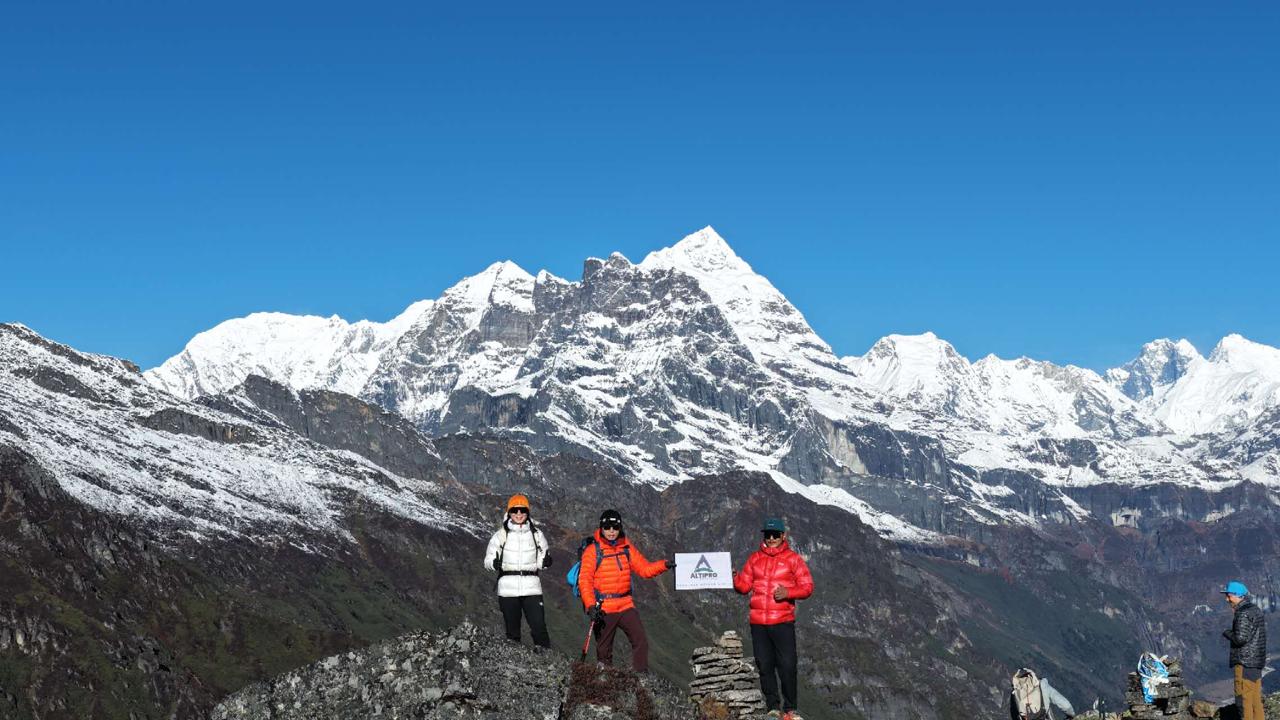
Makalu Base Camp Trek
Makalu Base Camp Trek — Beneath the Fifth-Highest Peak | AltiPro Adventures
Trek Overview
What is the Makalu Base Camp Trek?
The Makalu Base Camp Trek is one of Nepal's most remote and rewarding wilderness treks, travelling deep into the Makalu-Barun National Park to the base of the world's fifth-highest mountain — Makalu at 8,481 metres. AltiPro's 15-day itinerary flies from Kathmandu to Tumlingtar in eastern Nepal, then climbs through the Arun River valley, over the Shipton La, and into the wild upper Barun valley to Makalu Base Camp at 5,550 metres. The route passes through some of the most biodiverse forest in the Himalayas before breaking above the treeline into the glacier-carved upper Barun valley, where Makalu's four massive ridges converge into one of the most dramatic mountain silhouettes in the world.
The Barun valley sees only a fraction of the trekker numbers visiting the Khumbu and Annapurna regions — the upper valley beyond Shershon is one of the most pristine high-altitude environments accessible on foot in Nepal. Fully guided with an experienced leader with Makalu valley expertise, personal porter for each trekker, all teahouse and camping accommodation and meals, Makalu-Barun National Park permits and TIMS, and all transport including the Tumlingtar flight. Maximum 12 trekkers. Rated Challenging.
About Makalu and the Barun Valley
Makalu (8,481m) is the fifth-highest mountain on Earth and one of the most technically demanding of the 8,000m peaks. Its four-sided pyramid shape — four sharp ridges converging on the summit — makes it one of the most architecturally striking mountains in Nepal, visible from the Barun valley in full profile without the summit obscured by satellite peaks. The Barun valley is a glacially carved wilderness with permanent snowfields, braided glacial rivers, and high-altitude meadows beneath the towering east and south faces of the Makalu-Baruntse massif.
The Makalu-Barun National Park adjoins the Sagarmatha National Park on its western boundary, creating one of the great protected wilderness corridors in the Himalayas. The park's extraordinary biodiversity — from subtropical Arun valley forest to alpine tundra — makes the approach to Makalu Base Camp as rewarding ecologically as the mountain destination itself.
Why Choose AltiPro Adventures for the Makalu Base Camp Trek?
Barun Valley Expertise
AltiPro's team has extensive experience of the Barun valley approach — the correct acclimatisation staging, Shipton La crossing conditions, and the remote camp management required above Shershon where teahouse facilities end. Full camping capability is carried for the upper valley.
Personal Porter for Each Trekker
Every trekker has a dedicated personal porter, with AltiPro maintaining above-market wage standards, insurance, and proper equipment for all support staff on this demanding and remote route.
Small Group Size
Maximum 12 trekkers per departure — essential for remote camp management and personalised guiding on one of Nepal's most logistically demanding trekking routes.
Complete Logistics
All Makalu-Barun National Park permits and TIMS, domestic return flight to Tumlingtar, all accommodation and meals from teahouse to high camp — entirely managed by AltiPro.
True Wilderness
Only a handful of trekking groups visit the Barun valley each season. For trekkers seeking genuine Himalayan wilderness without the crowds of the Khumbu or Annapurna, the Makalu Base Camp Trek is in a category of its own.
Ecological Diversity
The Makalu-Barun National Park is one of Nepal's most biodiverse areas. Red panda, snow leopard, Himalayan black bear, and an extraordinary range of orchids and rhododendrons are all recorded in the park's forests on the approach to base camp.
Makalu Base Camp Trek — 15-Day Route Overview
The route flies to Tumlingtar, climbs through the Arun valley and Makalu-Barun National Park forest, crosses the Shipton La, and follows the remote Barun valley to the base camp beneath Makalu's south and east faces.
Days 1–2: Kathmandu → Tumlingtar (526m) → Num
Domestic flight from Kathmandu to Tumlingtar in the Arun valley. Begin trekking into the subtropical lower Arun through the diverse forest of the Makalu-Barun National Park's lowest elevations.
Days 3–6: Num → Seduwa → Tashigaon → Dobato (Shipton La)
The Shipton La crossing (4,127m) is the key pass on the route, transitioning from the Arun drainage to the Barun valley. Above Tashigaon the trail climbs steeply through the increasingly high-altitude forest before the open ridge of the pass.
Days 7–10: Barun Valley — Dobato → Yangri Kharka → Shershon (4,010m)
Descent into the Barun valley delivers the first views of the upper Makalu massif. The Barun valley floor at Shershon is the last permanent settlement — above here the valley is pure wilderness, with yak pastures, glacial rivers, and the massive south walls of the Makalu-Baruntse group closing the horizon.
Days 11–13: Shershon → High Camp → Makalu Base Camp (5,550m)
The upper Barun above Shershon requires camping. The route climbs through high pasture and moraine to Makalu Base Camp at 5,550m on the glacier edge — with Makalu's full four-ridged pyramid profile filling the sky directly ahead. Days at base camp allow exploration of the glacier and views of the southeast and northeast ridges.
Days 14–15: Descent — Barun Valley → Tumlingtar → Kathmandu
Rapid descent through the Barun valley and Arun approach to Tumlingtar for the domestic return flight to Kathmandu, completing the 15-day circuit.
How Difficult is the Makalu Base Camp Trek?
The Makalu Base Camp Trek is rated Challenging. The sustained remoteness, multi-day altitude above 4,000m, and the Shipton La crossing make this a demanding route. The upper valley above Shershon (4,010m) is increasingly rough and high, with base camp at 5,550m requiring sound acclimatisation. No technical climbing is involved. The chief challenges are fitness, acclimatisation, and remote trail navigation.
Best Season for the Makalu Base Camp Trek
Spring (April–May): The primary season — stable weather and clear conditions in the Barun valley with excellent Makalu views.
Autumn (October–November): Clear post-monsoon conditions with the best Makalu visibility and settled weather in the upper Barun.
Makalu Base Camp Trek Cost
Fully guided Makalu Base Camp expedition — all permits, Tumlingtar flight, accommodation, meals, guide, and personal porter included.
Includes all Makalu-Barun National Park permits and TIMS, Tumlingtar domestic return flight, all teahouse and camping accommodation and meals, licensed guide, and personal porter for each trekker. International flights and personal gear are not included. Contact AltiPro for full pricing.
Makalu Base Camp Trek — Frequently Asked Questions
Common questions about the Makalu Base Camp Trek with AltiPro Adventures.
How remote is the Makalu Base Camp Trek?
Extremely remote — only a handful of trekking groups visit the Barun valley each season. The upper valley above Shershon has no teahouse facilities. AltiPro carries full camping equipment for all upper valley stages.
How high does the trek reach?
Makalu Base Camp at 5,550 metres is the highest point and final destination. The highest sleeping altitude is the high camp below base camp at approximately 5,100 to 5,200 metres.
Is prior trekking experience required?
Yes. AltiPro recommends prior trekking experience above 4,000m and strong general fitness. The sustained multi-day effort and remoteness make this unsuitable as a first Himalayan trek.
How long is AltiPro's Makalu Trek?
15 days from Kathmandu return, including domestic flights and all trekking days in the Barun valley.
When is the best time to trek to Makalu Base Camp?
April and May for the primary spring season. October and November for post-monsoon clarity and stable conditions in the upper Barun.
What does the package include?
All Makalu-Barun National Park permits and TIMS, Tumlingtar domestic return flights, all accommodation and meals, licensed guide, and personal porter. International flights and personal equipment are not included.
How does Makalu compare to other base camp treks?
The Makalu Base Camp Trek is more remote and less visited than Everest or Annapurna base camp routes. The solitude, ecological diversity, and the dramatic isolation of Makalu's pyramid profile make it exceptional among Nepal's trekking destinations.
What wildlife might I see?
The Makalu-Barun National Park is one of Nepal's most biodiverse areas. Red panda, snow leopard, Himalayan black bear, various pheasant species, and an extraordinary range of orchids and rhododendrons are all recorded in the park.
Highlights
- Makalu Base Camp — 4,870 m / 15,977 ft
- Shipton La (4,125 m) & Keke La (4,170 m) — Twin Pass Day
- The Pristine Barun Valley Wilderness
- Barun Pokhari Glacial Lake — 5,100 m
- Khongma Danda — 3,500 m Himalayan Panorama
- Makalu Barun National Park — 440+ Bird Species
- Rai & Sherpa Cultural Villages
- One of Nepal's Rarest Trekking Achievements
Detailed Itinerary
Click on each day to view details
| Day | Program | Meals | Accom. | |||||||||||||||||||||||||||||||||||||||||||||||||||||||||||||||||||||||||||||||||||||||||||||||||||||||||||||||||||||||||||||||||||||||||||||||||||||||||||||||||||||||||||||||||||||||||||||||||||||||||
|---|---|---|---|---|---|---|---|---|---|---|---|---|---|---|---|---|---|---|---|---|---|---|---|---|---|---|---|---|---|---|---|---|---|---|---|---|---|---|---|---|---|---|---|---|---|---|---|---|---|---|---|---|---|---|---|---|---|---|---|---|---|---|---|---|---|---|---|---|---|---|---|---|---|---|---|---|---|---|---|---|---|---|---|---|---|---|---|---|---|---|---|---|---|---|---|---|---|---|---|---|---|---|---|---|---|---|---|---|---|---|---|---|---|---|---|---|---|---|---|---|---|---|---|---|---|---|---|---|---|---|---|---|---|---|---|---|---|---|---|---|---|---|---|---|---|---|---|---|---|---|---|---|---|---|---|---|---|---|---|---|---|---|---|---|---|---|---|---|---|---|---|---|---|---|---|---|---|---|---|---|---|---|---|---|---|---|---|---|---|---|---|---|---|---|---|---|---|---|---|---|---|---|---|---|
| 1 | Arrive Kathmandu (1,350 m / 4,429 ft) — Welcome Briefing | Dinner | Hotel, Kathmandu | |||||||||||||||||||||||||||||||||||||||||||||||||||||||||||||||||||||||||||||||||||||||||||||||||||||||||||||||||||||||||||||||||||||||||||||||||||||||||||||||||||||||||||||||||||||||||||||||||||||||||
|
Welcome to Nepal. An AltiPro representative meets you at Tribhuvan International Airport and transfers you to your hotel in Kathmandu (1,350 m). The evening begins with a welcome briefing covering the full Makalu Base Camp Trek 2027 itinerary, permits, gear checks, packing essentials and altitude protocols. Dinner at the hotel.
2
|
Kathmandu — Permit Processing & Gear Check |
Breakfast, Dinner |
Hotel, Kathmandu |
|
| A full day in Kathmandu for permit processing: Makalu Barun National Park Entry Permit, Makalu Rural Municipality Trekking Permit and TIMS Card arranged by AltiPro. Gear check and final briefing from your AltiPro guide. Opportunity to hire or purchase any missing trekking equipment in Thamel. Overnight in Kathmandu.
3
|
Fly Kathmandu → Tumlingtar (400 m); Drive → Num (1,560 m) |
Breakfast, Lunch, Dinner |
Lodge, Num |
|
| Early morning 50-minute domestic flight from Kathmandu to Tumlingtar Airport (400 m) in eastern Nepal. Drive approximately 3–4 hours via Khandbari to Num village (1,560 m) — the Makalu Base Camp trailhead. Num sits above the Arun River gorge on a forested ridge, with the first distant views of the Makalu massif visible to the north. The road ends here. Overnight at a lodge in Num.
4
|
Trek Num → Seduwa (1,500 m / 4,921 ft) |
Breakfast, Lunch, Dinner |
Lodge, Seduwa |
|
| The trek begins with a steep 350 m descent from Num to a suspension bridge over the Arun River, then a gruelling 900 m ascent — one of the most demanding individual climbs on the entire trek — to Seduwa (1,500 m). Seduwa is the official entry point to Makalu Barun National Park, where permits are checked. The lower approach passes through cardamom terraces and traditional Rai village culture. 5–6 hrs walking.
5
|
Trek Seduwa → Tashigaon (2,100 m / 6,890 ft) |
Breakfast, Lunch, Dinner |
Lodge/Camp, Tashigaon |
|
| The trail climbs from Seduwa through the villages of Hindrungma and Rupisa, ascending through cultivated hillsides and rhododendron forest to Tashigaon (2,100 m) — the last permanent Sherpa village on the route. Tashigaon is the final point of reliable teahouse accommodation and warm community life before the remote high-altitude terrain begins. Stock up and rest well — the big climbs start tomorrow. 4–5 hrs walking.
6
|
Trek Tashigaon → Khongma Danda (3,500 m / 11,483 ft) |
Breakfast, Lunch, Dinner |
Teahouse, Khongma Danda |
|
| The most demanding ascent of the entire approach — a 1,400 m climb through dense rhododendron and bamboo forest to the open ridge at Khongma Danda (3,500 m). The forest is exceptional in spring, with rhododendrons in full bloom and extraordinary bird diversity. Above the treeline, the ridge opens to the first full panorama of Makalu (8,485 m), Chamlang (7,319 m) and the eastern Himalayan chain. Two basic teahouses exist at Khongma Danda. 6–7 hrs walking / 1,400 m ascent.
7
|
Acclimatisation Day at Khongma Danda (3,500 m) |
Breakfast, Lunch, Dinner |
Teahouse, Khongma Danda |
|
| A mandatory rest and acclimatisation day at Khongma Danda before crossing the high passes. AltiPro guides lead optional short hikes to nearby ridges above 3,700 m to aid acclimatisation — the "climb high, sleep low" protocol. Rest, hydrate, eat well and prepare mentally and physically for the most challenging day of the trek: the double pass crossing that lies ahead. The evening panorama of Makalu at dusk from Khongma Danda is extraordinary.
8
|
Trek Khongma Danda → Shipton La (4,125 m) → Keke La (4,170 m) → Dobate (3,650 m) |
Breakfast, Lunch, Dinner |
Camp/Tent, Dobate |
|
| The most dramatic and memorable day of the Makalu Base Camp Trek — crossing both Shipton La (4,125 m / 13,533 ft) and Keke La (4,170 m / 13,681 ft) in succession. Both passes are named after and associated with the pioneering mountaineer Eric Shipton, who first explored this terrain. Both are high, exposed and frequently snow-covered in spring and autumn. The views from both pass summits across the eastern Himalayan range are exceptional. Descend to the seasonal teahouse outpost at Dobate (3,650 m). 8–9 hrs walking.
9
|
Trek Dobate → Yangri Kharka (3,557 m / 11,669 ft) |
Breakfast, Lunch, Dinner |
Camp/Teahouse |
|
| From Dobate, the trail descends into the wide glacial expanse of the upper Barun Valley — open alpine meadows grazed by yaks, with moraines and glacial debris replacing the forest and ridge terrain of the approach. Makalu begins to dominate the entire northern skyline as the Barun Valley opens. Trek to Yangri Kharka (3,557 m) — a yak grazing outpost with seasonal accommodation. The Barun Glacier appears at the head of the valley. 4–5 hrs walking.
10
|
Trek Yangri Kharka → Langmale Kharka (4,410 m / 14,468 ft) |
Breakfast, Lunch, Dinner |
Camp, Langmale Kharka |
|
| The approach to Base Camp gets serious. The trail climbs steadily from Yangri Kharka through increasingly glacial terrain — lateral moraines, glacial streams and open rocky ground — to Langmale Kharka (4,410 m), the last adequate campsite before Base Camp. The scale of Makalu becomes truly undeniable from here — the south face looms enormous directly above. The Barun Glacier fills the valley floor to the north. 4–5 hrs walking / 853 m ascent.
11
|
Trek Langmale Kharka → Shershong → Makalu Base Camp (4,870 m / 15,977 ft) |
Breakfast, Lunch, Dinner |
Camp, Makalu Base Camp |
|
| Base Camp day — the summit objective of the trek. The trail crosses the terminal moraine of the Barun Glacier, passing through Shershong, and reaches Makalu Base Camp (4,870 m / 15,977 ft) directly beneath the south face of Makalu. Everest (8,849 m), Lhotse (8,516 m) and Baruntse (7,129 m) stand on the ridges above. For those with energy and conditions permitting, continue to approximately 5,100 m toward the Upper Base Camp area and Barun Pokhari glacial lake. Overnight at Base Camp. 4–5 hrs walking.
12
|
Exploration Day at Makalu Base Camp (4,870 m) |
Breakfast, Lunch, Dinner |
Camp, Makalu Base Camp |
|
| A full day at Makalu Base Camp for exploration, photography and absorption. The Barun Pokhari glacial lake (approximately 5,100 m) is within reach for the energetic — conditions and visibility permitting. The panorama from Base Camp — Makalu's south face directly overhead, Everest and Lhotse to the northwest, Baruntse above — is one of the finest mountain viewpoints accessible to non-technical trekkers anywhere in the Himalaya. Overnight at Base Camp.
13
|
Begin Descent — Base Camp → Yangri Kharka (3,557 m) |
Breakfast, Lunch, Dinner |
Camp/Teahouse |
|
| Begin the return to Kathmandu, retracing the Barun Valley southward from Base Camp through Shershong and back down the moraine to Yangri Kharka (3,557 m). The descent from 4,870 m to 3,557 m in a day significantly reduces altitude stress. The valley feels different on the return — broader, warmer, and familiar after the high-altitude intensity of Base Camp. 5–6 hrs walking / 1,313 m descent.
14
|
Trek Yangri Kharka → Dobate (3,650 m) |
Breakfast, Lunch, Dinner |
Camp/Tent |
|
| Gradual ascent from Yangri Kharka back toward the pass zone, returning to Dobate (3,650 m) — the seasonal teahouse outpost below Keke La and Shipton La. The terrain of the upper Barun Valley — now familiar from the approach — passes quickly. Morale is typically high on the return, with Base Camp achieved and the complexity of the route now understood. 4–5 hrs walking.
15
|
Trek Dobate → Keke La (4,170 m) → Shipton La (4,125 m) → Khongma Danda (3,500 m) |
Breakfast, Lunch, Dinner |
Teahouse, Khongma Danda |
|
| Re-cross both high passes in the opposite direction — Keke La and then Shipton La — with the eastern Himalayan panorama opening behind you as you descend toward Khongma Danda. The view from the passes on the return perspective, looking back toward the Barun Valley and Makalu, is different and equally powerful. Descend through the forest to Khongma Danda. 8–9 hrs walking.
16
|
Trek Khongma Danda (3,500 m) → Tashigaon (2,100 m) |
Breakfast, Lunch, Dinner |
Lodge/Camp, Tashigaon |
|
| A long 1,400 m descent through rhododendron and bamboo forest from Khongma Danda back to Tashigaon (2,100 m). The descent feels rapid after the altitude — the forest warms noticeably with every 100 m of descent, and the sounds and smells of the permanent village return. Tashigaon marks the return to civilisation — hot food, comfortable lodges and reliable communication. 5–6 hrs walking.
17
|
Trek Tashigaon → Seduwa (1,500 m) |
Breakfast, Lunch, Dinner |
Lodge, Seduwa |
|
| Comfortable descent from Tashigaon through Rupisa and Hindrungma to Seduwa (1,500 m). The trail passes back through lower farmland and Rai village culture — cardamom terraces and traditional community life that the high-altitude section cannot provide. The cultural warmth of the lower approach trail comes alive on the return. 4–5 hrs walking.
18
|
Trek Seduwa → Num (1,560 m); Drive → Tumlingtar (400 m) |
Breakfast, Lunch, Dinner |
Lodge, Tumlingtar |
|
| Final trekking day — descent from Seduwa across the Arun River suspension bridge and back up the steep trail to Num (1,560 m). Drive from Num to Tumlingtar (400 m) via Khandbari — approximately 3–4 hours. Overnight in Tumlingtar for the morning flight back to Kathmandu. Buffer days at Tumlingtar are built into the AltiPro itinerary for weather or flight delays — common at this remote domestic airport.
19
|
Fly Tumlingtar → Kathmandu — Farewell Dinner |
Breakfast, Farewell Dinner |
Hotel, Kathmandu |
|
| Morning flight (50 minutes) from Tumlingtar back to Kathmandu. Transfer to hotel in Thamel. Afternoon free for last-minute shopping, sightseeing (Pashupatinath, Boudhanath, Swayambhunath) or rest. Evening farewell dinner with your AltiPro guide and team — Makalu Base Camp Trek certificate presented. A proper celebration of one of Nepal's most demanding and rewarding trekking achievements.
20
|
Buffer Day — Kathmandu (flight or weather contingency) |
Breakfast |
Hotel, Kathmandu |
|
| Buffer day built into the itinerary to account for possible flight cancellations at Tumlingtar due to weather or visibility (mountain fog is common at this eastern Nepal airstrip). If no delays occur, this day is free in Kathmandu for additional sightseeing or shopping. AltiPro always includes buffer days in the Makalu Base Camp itinerary — the Tumlingtar flight delay is a known variable and must be planned for.
21
|
Final Departure from Kathmandu |
Breakfast |
None |
|
| Breakfast at the hotel and transfer to Tribhuvan International Airport according to your flight schedule. AltiPro arranges airport transfers for all departure times. Carry your Makalu Base Camp memories home — the south face of the fifth-highest mountain, the Barun Pokhari glacial lake at 5,100 m, the double pass crossing at Keke La and Shipton La, and the extraordinary wilderness of a valley that fewer than 1,500 trekkers per year see. | ||||||||||||||||||||||||||||||||||||||||||||||||||||||||||||||||||||||||||||||||||||
Services
Includes
- ✅ Makalu Barun National Park Entry Permit, Makalu Rural Municipality Trekking Permit and TIMS Card — all arranged and paid for by AltiPro in Kathmandu. Nepal government taxes and company service charges included.
- ✅ 4 nights hotel in Kathmandu (BB, single room). Welcome and farewell dinners in Kathmandu. All domestic flights: Kathmandu–Tumlingtar return for all members and staff. Jeep transport: Tumlingtar–Num and return. Full board accommodation throughout the trek — teahouse (Num to Tashigaon) and tented camp with catering (above Tashigaon to Base Camp). 3 meals per day (BLD) throughout. Tea and coffee with all meals.
- ✅ One experienced, government-licensed trekking guide for the full duration. Porter support — up to 20 kg per member. All Nepali staff and porter daily wages, salary, equipment, food, clothing and insurance. Porter welfare managed to AltiPro standards throughout.
- ✅ Satellite phone for emergency communication throughout the trek. 6-hourly weather forecast service. Comprehensive first aid medical kit and altitude management protocol. Emergency helicopter evacuation coordination — standby pre-arranged from Kathmandu. AltiPro trekking map, route guide and branded duffle bag included.
Excludes
- ❌ International flights to and from Kathmandu are not included. Nepal tourist visa fees are not included — USD 125 for a 90-day visa, available on arrival at Tribhuvan International Airport or via the Nepal eVisa portal. Lunch and dinner in Kathmandu except the included welcome and farewell dinners are not included.
- ❌ Comprehensive travel, medical and high-altitude helicopter rescue insurance is not included — mandatory for all Makalu Base Camp Trek participants. Insurance must cover emergency evacuation to at least 5,500 m. World Nomads and IMG Global are recommended providers. AltiPro will not permit trekking without confirmed evacuation insurance.
- ❌ Personal trekking gear (sleeping bag rated –15°C minimum for above Tashigaon, trekking poles, waterproof boots, down jacket, head torch) not included. Gear rental available in Kathmandu's Thamel district at low daily rates — AltiPro recommends trusted suppliers. Personal expenses: hot showers, device charging, laundry, snacks, alcoholic beverages and souvenirs not included.
- ❌ Tips for the trekking guide (minimum USD 150 per guide), porters (minimum USD 80–100 per porter) and kitchen/support staff are not included. Gratuities are discretionary but customary in Nepal's trekking industry and constitute a significant portion of local guide and porter income. Special filming, camera and drone permit fees not included. Costs due to flight cancellations, road disruptions or unforeseen circumstances not included.
Gear Lists & Useful Information
Been on this trek?
Your feedback helps other travelers plan their adventure of a lifetime. Share your experience with us!
Ready to Start Your Trekking Adventure?
Contact us to book your trek or get more information